While you're optimizing CAC, your backend operations are destroying the profitability those ads generate. 80% of D2C brands fail not from high CAC, but from operational inefficiency that compounds as they scale.
The D2C Profitability Illusion
You're spending ₹10 lakhs per month on Facebook and Google ads. Your CAC is climbing. ROAS is declining. And your marketing team keeps asking for more budget.
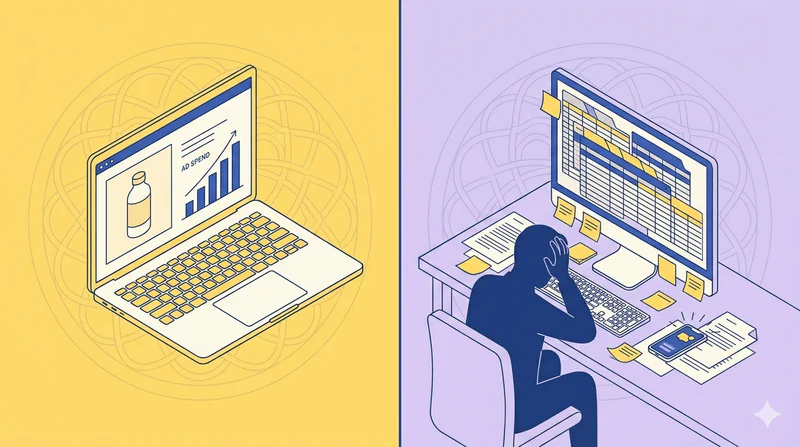
But here's what nobody's telling you: Your D2C brand doesn't have a marketing problem. It has an operations problem.
While you're optimizing ad creatives and testing landing pages, your backend is quietly destroying the profitability those ads are supposed to generate.
Orders sit in 'processing' for 3 days. Inventory shows 50 units in Shopify, 45 on Amazon, 52 in your warehouse - nobody knows which number is real. Your team chases approvals on WhatsApp. COD reconciliation takes 40 hours monthly. And you're still using Excel to track 'real' inventory.
Over 80% of D2C ventures in India haven't achieved profitability, despite massive marketing investments. The reason isn't CAC - it's what happens after the customer clicks 'buy.'
1.The D2C Profitability Crisis Nobody Talks About:
The Numbers Don't Lie
70% of Indian D2C brands fail within their first year, and over 80% struggle to achieve profitability. But here's what's shocking: It's not because they can't acquire customers.
Customer acquisition costs have increased 3–4x from pre-pandemic levels, with brands now paying $25–91 per customer depending on industry, yet brands are still growing order volumes.
The problem? Fulfillment costs increased 23% year-over-year, packaging sustainability requirements add 15–20% to material costs, and operational chaos is eating profits faster than marketing can generate them.
The Hidden Profitability Equation
Most D2C founders obsess over this equation:
CAC < LTV = Profitable
But the real equation determining profitability is:
(Revenue per Order) − (CAC + Fulfillment Cost + Operational Waste + Working Capital Cost) = Actual Profit
2. Why Marketing Isn't Your Real Problem
The CAC Distraction
Every D2C founder knows their CAC. Few know their true fulfillment cost per order.
62% of founders report creative fatigue, where repeated creatives fail to sustain ROAS despite higher spends. So they blame marketing and keep testing new ads.
But here's what they're missing:
The Profitability Math That Exposes Operations
Let's compare two identical D2C brands:

Brand B makes 80% more profit per order despite having higher CAC. This is the power of operations optimization.
3. The 7 Operational Bottlenecks Killing D2C Brands
Based on analysis of 800+ Indian D2C brands, these are the critical breaking points:
Bottleneck #1: Inventory Anarchy
The Problem: Manual inventory tracking across multiple systems with no real-time sync
What This Costs: 43% of small businesses lose sales due to inefficient inventory management. Stockouts damage CLV, SEO rankings, and ad ROI.
The Excel Trap: Excel can't sync real-time, alert automatically, or handle multi-warehouse allocation
The ERP Solution: Real-time visibility, automated reorder points, multi-channel sync, AI-powered forecasting
Bottleneck #2: WhatsApp Workflow Disease
The Problem: Operations run via WhatsApp groups with constant status chasing
What This Costs: 3–4 hours daily per team member, 2–3 day approval delays, zero audit trail
The Tally Limitation: Tally handles accounting, not workflows - can't route approvals or provide status visibility
The Solution: Automated workflow routing, real-time visibility, OMS/WMS integration, audit trails
Bottleneck #3: Multi-Channel Inventory Mayhem
The Problem: Different inventory numbers across Shopify, Amazon, warehouse overselling during sales
What This Costs: Canceled orders, angry customers, can't run promotions confidently
The Excel Impossibility: Excel cannot provide real-time cross-platform synchronization
The ERP Solution: Unified inventory view, real-time sync, automated reservation and allocation
Bottleneck #4: COD Reconciliation Hell
The Problem: Manual reconciliation of COD orders taking 30–40 hours monthly
What This Costs: Working capital trapped, hidden RTO costs eating 10–15% of COD orders
The Tally Gap: Tally records transactions but doesn't auto-reconcile or track RTO patterns
The Solution: Automated reconciliation with logistics partners, RTO analysis, true cost calculation
4. The Real Cost of Excel-Based Operations

For the first ₹50 lakhs in revenue, Excel works. But somewhere between ₹5–10 Cr annual revenue, Excel becomes your biggest bottleneck.
The Hidden Costs:
Time Waste: ₹8–12 Lakhs annually (manual data entry, error correction)
Stockout Lost Sales: ₹20–40 Lakhs annually (5–10% of potential revenue)
Overstock Working Capital: ₹15–25 Lakhs trapped (slow-moving inventory)
Error Cost: ₹5–10 Lakhs annually (wrong shipments, double orders)
Opportunity Cost: Priceless (can't scale marketing, founder time wasted)
Total Annual Cost of Excel Operations: ₹50–90 Lakhs
5. From Excel to ERP: The D2C Operational Stack
The Operational Maturity Curve
Stage 1: ₹0–2 Cr (Spreadsheet Hustle) - Shopify + Excel + WhatsApp. Works because volume is low.
Stage 2: ₹2–10 Cr (Breaking Point) - Excel becomes complex, team grows but chaos multiplies. This is where most D2C brands get stuck.
Stage 3: ₹10–50 Cr (Tool Sprawl) - 12+ disconnected tools, data in silos, 'integration' means CSV exports.
Stage 4: ₹50+ Cr (Integrated Operations) - Unified ERP, automated workflows, data-driven decisions.
The Right Stack for ₹5–50 Cr D2C Brands
Core: Modular ERP - Order management, unified inventory, purchase management, warehouse, financial integration
Quality Layer: QMS Integration - Inbound inspection, quality checks, return workflows, supplier scorecards
Fulfillment Layer: Distributed Order Management, automated routing, 3PL integration, tracking
Analytics Layer: Real-time dashboards, SKU-level profitability, cohort analysis
Why 'Modular' Matters
Traditional ERPs (SAP/Oracle): ₹50 lakhs–₹2 crores, 12–18 months deployment, force you to change your business to fit the tool.
Modular D2C ERP (like Journeyfy): Start with what you need NOW, add modules as you scale, 90-day implementation, built around how D2C actually works, cost 1/10th of traditional ERP.
6. The Journeyfy Framework: Operations-First Scaling
The Problem Journeyfy Solves
You're between Chaos (Excel + Tally + 12 disconnected tools) and Overkill (SAP implementation costing ₹2 crores). You need: Growth infrastructure that matches your actual business (₹2–200 Cr revenue).
The Journeyfy 4-Step Approach
Step 1: Identify Your ONE Breaking Journey (Week 1–2) - Find the bottleneck costing you the most through workaround analysis, not surveys.
Step 2: Build Minimum Viable System (Week 3–8) - Build the smallest system that unbreaks your primary bottleneck. Don't solve everything, solve ONE thing completely.
Step 3: Stabilize & Measure (Week 9–12) - Ensure >80% adoption, measure actual impact, validate the pain is solved.
Step 4: Layer the Next Priority (Quarter 2+) - Only after first module works, add the next priority.
Example: Fashion Brand at ₹15 Cr Revenue
Breaking Point: Multi-channel inventory chaos -overselling 50+ units monthly, 3 hours daily on manual allocation.
What We Built: Real-time inventory sync (Shopify + Amazon + Website), automated allocation, low-stock alerts, purchase order automation.
What We Didn't Build: Financial accounting, HR management, production planning, advanced analytics, CRM features.
Result: Overselling 50+ → 0 units, allocation time 3 hours → automated, ran 3x more promotions, ROI: ₹18 lakhs saved in first year.
7. Real D2C Case Studies: Operations vs. Marketing
Case Study: SNITCH - From Chaos to ₹100 Cr+
Operational Problems:
No unified inventory view across D2C, marketplaces, and offline stores
Fast-fashion trends required agile inventory management
Store credit not integrated between online and offline
Solution: Cloud-based ERP system with open API capabilities
Results:
Seamless integration across all sales channels
Scaled from D2C to omnichannel without operational breakdown
Unified customer data enabling personalization
Marketing Lesson: Growth wasn't limited by CAC - it was limited by operational capacity
Key Takeaways
80% of D2C brands fail not from CAC, but from operational inefficiency destroying profitability
Fulfillment costs increased 23% YoY while brands focus on optimizing CAC by 10% — wrong priority
44% of D2C brands identify logistics as their major problem, yet invest 10x more in marketing
Excel and Tally hit hard limits at ₹5–10 Cr revenue, costing ₹50–90 lakhs annually in hidden waste
Operations improvements compound as you scale; marketing improvements face diminishing returns
Modular ERP beats traditional ERP for ₹2–200 Cr D2C: 1/10th cost, 90-day deployment, immediate ROI
Fix ONE operational journey at a time in 90-day cycles vs. implementing everything at once
Real-time inventory sync, automated workflows, and unified data are non-negotiable for profitable scaling
QMS integration is critical for D2C brands with >15% return rates to identify patterns and reduce waste
Operations-first brands can afford higher CAC because their unit economics are sound

Conclusion: Operations as Competitive Advantage
Your competition is optimizing their Facebook ads. You should be optimizing your operations.
Because here's the truth about D2C in 2025: The next generation of ₹100 crore D2C brands is likely to be defined not by speed, but by the ability to compound cash flows, institutionalize processes, and scale distribution beyond digital platforms.
Marketing gets you customers. Operations keeps them profitable.
Investors now scrutinize unit economics obsessively: CAC payback periods under 6 months, contribution margins above 30%, and clear evidence of pricing power without heavy discounting.
You can't achieve this with Excel, Tally, and WhatsApp.
Ready to fix operations before your next marketing push? Journeyfy helps D2C brands fix operations without traditional ERP overkill - 90-day implementation, modular growth, journey-first approach.