Somewhere on your shop floor right now, a machine is running below capacity. A batch of raw material was consumed this morning but will only be posted to your system tonight. A job worker returned goods three days ago and the delivery challan is sitting in someone's inbox unmatched, untracked, quietly accumulating GST exposure.
None of this appears on your P&L today. This is not a management failure. It is a systems architecture failure and it is the exact problem manufacturing ERP software exists to solve.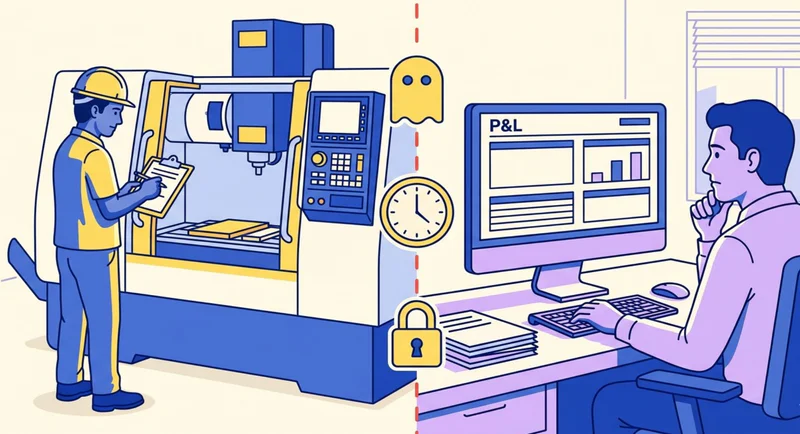
If you are running a manufacturing business in India whether you are a legacy SME fighting operation chaos or a manufacturing startuptrying to build clean systems from day one this guide will show you exactly what a well-implemented manufacturing ERP software does, why it matters at every revenue stage, and what Indian-specific compliance it must handle natively.
What is Manufacturing ERP Software? | Industry ERP Explained
Manufacturing ERP software (Enterprise Resource Planning software) is an integrated digital operating system that connects every function of a manufacturing business - production planning, Bill of Materials (BOM) management, inventory control, procurement, shop floor execution, job work tracking, finance, and regulatory compliance into a single, real-time platform.
Unlike generic business software or accounting tools like Tally, a dedicated industry ERP for manufacturing understands the physics of a factory: that raw materials transform into finished goods through operations that consume time, labour, and machine capacity and that every rupee of variance between what should have happened and what did happen is a signal about where your business is leaking money.
In short, manufacturing ERP software transforms a factory from a place managed by instinct to a business managed by data. For manufacturing startups building their operational stack for the first time, implementing the right ERP software early is the single highest-leverage infrastructure investment you can make.
Not sure if your business communication is causing as much chaos as your systems? Read our related piece: Your WhatsApp Group Is Not a Business Operating System →
Why Indian Manufacturing Has a Shop-Floor-to-Finance Disconnect
The India manufacturing ERP software market was valued at $424 million in 2022 and is projected to reach $651 million by 2029, growing at 6.32% annually. Indian SMEs now comprise around 60% of manufacturing ERP buyers, driven by affordable SaaS ERP softwaredelivered on the cloud and a growing pool of skilled implementation professionals.
Yet most Indian manufacturers between ₹5 Cr and ₹100 Cr still run on a dangerous combination: Tally for accounts, Excel for production, and human memory for everything in between - with the shop floor and the balance sheet connected by nothing more reliable than a daily phone call between the plant head and the accounts manager.
⚠️ The Operation Chaos Checklist: If any of these are true, your business is losing money it cannot see.
You have more than one product line or more than one machine running simultaneously
You use job workers for any part of your production process
You manufacture to order AND maintain finished goods stock simultaneously
You have inter-state raw material procurement with multiple HSN codes and mixed GST rates
You cannot answer, at 10 AM on any Tuesday, whether your business made money this month
Your finance team spends 2–3 weeks every month consolidating data from multiple plants or locations
This operation chaos is structural, not cultural. Indian manufacturers grew their shop floors faster than their systems. The good news: streamlining this disconnect with the right manufacturing ERP software is now faster and more affordable than ever, especially with modern SaaS ERP software that can go live module by module without a 12-month implementation nightmare.
📊 Manufacturing organisations implementing ERP software reported a 32% reduction in inventory carrying costs, a 45% decrease in production bottlenecks, and a 67% improvement in supplier communication efficiency.
The gap between what a manufacturer knows today and what they could know with a properly implemented industry ERP is not a small operational gap. It is the difference between managing a factory and guessing how a factory is performing.
Why the BOM Is the Most Expensive Document in Your Factory

Everything in manufacturing flows from the Bill of Materials (BOM). The BOM is not a list. It is the financial specification of your product the exact quantity of every raw material, sub-assembly, consumable, and labour operation needed to produce one unit. In a well-implemented manufacturing ERP software, the BOM is a living document that drives procurement, production scheduling, cost accounting, and inventory management simultaneously.
Poorly maintained BOMs are among the biggest hidden cost drivers in Indian manufacturing. Missing subcomponents mean materials go unaccounted for. Outdated prices skew your COGS. Inconsistent revisions across departments break cost rollups and create standard vs. actual discrepancies that your CA can only spot months later by which time the loss has compounded across hundreds of production runs.
💡 The 70% Rule: Approximately 70% of product cost is determined during the BOM definition stage. Every error locked into a BOM at the design phase compounds across every production run for the life of the product. Manufacturing ERP software with proper BOM version control is not a nice-to-have - it is your primary cost management tool.
In a factory running without ERP software, the BOM degrades predictably over time:
Substitute materials get used without updating the BOM → standard cost is permanently wrong
Scrap percentages are not built into the BOM → consumption always appears "over" with no explainable cause
Engineering changes reach design but never reach the production floor → operators work from memory, not specification
The same product has different BOMs in different departments → procurement buys wrong quantities, every cycle
A manufacturing ERP software with an integrated BOM module enforces a single source of truth. Every change goes through an Engineering Change Order (ECO) process. Every revision is timestamped and version-controlled. Every production order is automatically linked to the correct BOM version. Cost rollups happen in real time. This is what streamlining your production cost management looks like in practice.
Standard Cost vs. Actual Cost: The Variance That Tells You Everything

Most Indian manufacturers think about cost at the product level: "This SKU costs approximately ₹X to make." A manufacturing ERP software introduces a far more powerful accounting model standard costing with real-time variance analysis that turns cost management from a quarterly estimate into a daily operational intelligence tool.
Standard cost is what the product should cost, based on the BOM (materials at standard prices) + routing-defined labour hours at standard rates + overhead absorption rate. Set at the start of each period in your ERP software.
Actual cost is what the product did cost - based on actual material consumption posted in the manufacturing ERP, actual machine time recorded on the production order, and actual labour clocked against the routing.
The variance - standard minus actual is the most valuable number in a manufacturing P&L. It tells you, in real time:
⚡ Without ERP software, these variances surface when your CA prepares annual accounts - 6 to 18 months after the fact, when corrective action is useless. With manufacturing ERP software, every variance is visible the day after the production order closes. That's 250 opportunities per year to catch and fix a cost leak before it compounds.
For manufacturing startups especially, building this cost visibility discipline from the first production run rather than retrofitting it years later when margins are already eroded is what separates businesses that scale from businesses that plateau.
The Theory of Constraints Applied to Shop Floor ERP
Every manufacturing plant has one process that limits the output of the entire system. The Theory of Constraints, developed by Eliyahu Goldratt, calls this the constraint - the single bottleneck that determines your plant's maximum throughput regardless of how efficiently every other process runs.
Capacity Requirements Planning (CRP) - Bottleneck Detection Before It Costs You
When the production plan is entered into the ERP, the system automatically calculates the load on every work centre (machine + operator combination) for every day of the planning horizon. If Machine 3 is loaded at 140% of capacity in Week 2 while all other machines run at 70%, the constraint is identified before the week begins not on Thursday when the dispatch deadline is already missed.
Work-in-Progress Queue Visibility - The Live Bottleneck Dashboard
Your manufacturing ERP software shows the queue at every work centre in real time. If 200 units are waiting in front of the painting station and only 40 units are queued at every other station, the painting station is the current constraint. Management can then make an informed decision: add a shift, outsource the painting operation temporarily, or reschedule other orders before the bottleneck causes a delivery failure.
Throughput Accounting - Scheduling Your Constraint Like a CFO
The ERP calculates output per unit of bottleneck time the only metric that matters under TOC when your goal is streamlining throughput. A product that takes 30 minutes on the constraint machine and sells at ₹1,200 has higher throughput per constraint minute than a product that takes 10 minutes and sells at ₹500. This sequencing decision which product to prioritise on the constraint is made by the scheduling module, not by instinct or whoever shouted loudest this morning.
This is where industry ERP software pays for itself fastest: not in accounting efficiency, but in production throughput. More units shipped per month from the same factory, without adding headcount or machinery.
The Job Work Time Bomb: India's Most Underestimated Manufacturing Risk

What a Manufacturing ERP Software Does With Job Work - Step by Step
Every goods despatch to a job worker creates a Sub-Contracting Order in the system: item, quantity, job worker GSTIN, delivery challan number, date of removal
The system calculates return deadlines automatically: inputs = 1 year from removal date, capital goods = 3 years
At 80% of the time limit elapsed: automated alert to production manager and accounts team
At 95% of the time limit: escalation to CFO with the exact tax exposure (quantity × GST rate × 18% interest accrued to date)
When goods return: GRN posted against the sub-contracting order, DC matched, ITC-04 line auto-populated
At filing time: ITC-04 is system-generated, not manually compiled. Filing takes minutes, not days. No surprises.
This single feature alone justifies the investment in manufacturing ERP software for any Indian business that uses job workers. The operation chaos in job work compliance is not visible until it is expensive - and by then, the interest clock has been running for months.
India-Specific Compliance That a Manufacturing ERP Must Own Natively
Any ERP software marketed to Indian manufacturers must handle the following without manual intervention. These are not features - they are legal obligations that carry financial penalties if missed. When evaluating manufacturing ERP software for your business, treat native compliance support as a non-negotiable baseline, not a premium add-on.
E-Invoicing (Mandatory Above ₹5 Cr Turnover)
Every B2B tax invoice must be registered on the Invoice Registration Portal (IRP) before it is legally valid. A buyer cannot claim Input Tax Credit (ITC) on an invoice without a valid IRN. In a manufacturing ERP, this is fully automated: invoice generated → JSON pushed to IRP → IRN and QR code returned → embedded on the printed invoice → auto-populated in GSTR-1 for the period. No separate login. No manual steps. Zero risk of invalid invoices.
E-Way Bills for Every Goods Movement Above ₹50,000
Every stock transfer raw material to job worker, inter-factory transfer, finished goods to depot, goods returned from sub-contractor requires an E-Way Bill if value exceeds ₹50,000. In a manufacturing ERP, every delivery challan or stock transfer order above the threshold auto-triggers E-Way Bill generation via the NIC portal API. Driver and vehicle details are captured at despatch. EWB number is attached to the despatch document. No separate NIC portal login required.
Three-Way Match Before Every Vendor Payment
The three-way match verifying that the vendor invoice matches both the Purchase Order and the Goods Receipt Note within defined tolerances before any payment is processed is the single most effective fraud control in manufacturing procurement. 90.9% of organisations implementing ERP reported realising expected benefits in inventory management, and 76.2% reported improved supplier interactions. The three-way match in ERP software is a major driver of both outcomes. It also protects against duplicate payments, inflated invoices, and unauthorised procurement common sources of silent cash leakage in fast-growing manufacturing businesses.
MSME Payment Terms - Automatic Monitoring
Under the MSMED Act, payments to registered MSMEs must be made within 45 days. Late payment attracts compound interest at three times the bank rate, and delayed payments must be disclosed in financial statements. A manufacturing ERP tracks MSME vendor registration status, auto-calculates payment due dates from the GRN date, and alerts the accounts team before the deadline crosses replacing a compliance risk with a routine notification.
Multi-GST Rate Handling - For Complex BOMs
Indian manufacturers frequently use raw materials that span multiple GST rate slabs (5%, 12%, 18%, 28%). In a manufacturing ERP, every item master carries its HSN code and applicable GST rate. Every purchase order, GRN, and invoice automatically applies the correct rate. ITC is calculated at the line item level. The result: zero manual GST calculations, zero rate errors, and clean ITC reconciliation at every GSTR-2B filing.
Why Manufacturing Startups Must Implement ERP Software Early - Not Later
One of the most expensive mistakes a manufacturing startup can make is treating ERP software as a "scale problem" - something to implement once you hit ₹25 Cr or ₹50 Cr. By that point, the cost of implementation is three times higher, the disruption is three times greater, and you have years of dirty data to clean up before the system can give you reliable insights.
The economics are clear: implementing manufacturing ERP software at ₹8 Cr costs roughly the same as at ₹40 Cr. The difference is what you buildwith it.
The Manufacturing Startup ERP Advantage:
Clean data from Day 1 no legacy mess to migrate
Team trained on the system before bad habits are entrenched
Investor-ready financial reporting from the first quarter
GST compliance automated before you hit the ₹5 Cr e-invoicing threshold
New product lines and plants onboarded without operational chaos
Variance data from the first production run -compounding into a cost intelligence asset over time
Manufacturing startups that implement the right SaaS ERP softwareearly don't just run more efficiently — they build a competitive moat. They can quote faster, deliver more reliably, and know their true margins when competitors are still guessing.
Building a business from scratch? The principles of streamlining operations apply beyond manufacturing too — read how independent professionals structure for scale →
How to Choose the Right Manufacturing ERP Software for Your Business
Not all ERP software is built for Indian manufacturing. Here is a structured framework for evaluating your options:
The best manufacturing ERP software for Indian SMEs and startups is one that respects your current complexity, goes live fast, and grows with you not one that forces a full business transformation before you see a single report.
FAQ
We manufacture using job workers for 60% of our production. Is that a high compliance risk?
Yes, and it is one of the most common undisclosed liabilities in Indian manufacturing audits. If your delivery challans are tracked manually and your ITC-04 is compiled from memory at filing time, you almost certainly have some overdue items approaching or past the 1-year return deadline. The first step is a full reconciliation: list every DC outstanding, match it against returns, and calculate days elapsed. A manufacturing ERP with sub-contracting module makes this continuous and automatic going forward.
We track our BOM in Excel. What is the actual financial risk?
Every time actual material consumption differs from your Excel BOM and nobody records the variance, the difference disappears - absorbed into "raw material purchases" at month-end. Over a year, a 3% usage variance on an ₹18 Cr raw material base is ₹54 lakh of untracked cost. You cannot recover what you cannot see. An ERP posts that variance to a named account the moment the production order closes, showing you which product, which machine, which batch is responsible.
What does "standard cost" mean and why does it matter for us?
Standard cost is the pre-defined cost of making one unit of your product, calculated from BOM (materials) and routing (labour + machine time). Every time you actually produce a unit, the ERP compares actual cost to standard cost and posts the difference as a variance. Positive variance (actual cost higher than standard) tells you where you are losing money. Negative variance (actual cost lower than standard) tells you where your standard is set incorrectly. Without this comparison, you know your total cost but not where it is coming from.
How does a manufacturing ERP handle multi-location production multiple plants or depots?
Each factory or depot is configured as a separate plant and company code within the same system. Inventory is tracked by location. Inter-location transfers generate e-way bills automatically and follow IGST rules for inter-state movements. The consolidated P&L shows all entities together; location-level P&Ls show individual plant profitability. This replaces separate Tally instances at each location with one integrated system - eliminating the manual consolidation that typically takes 2–3 weeks per month.
At ₹8 Cr revenue, is ERP worth it for a manufacturer?
₹5–15 Cr is the ideal window for manufacturing ERP implementation. Your processes are small enough to document cleanly. Your team is small enough to train efficiently. But your transaction volume and compliance complexity multiple vendors, job workers, GST filings, e-invoicing is high enough that the ROI is immediate. A manufacturer at ₹8 Cr with job workers, 15+ active raw material suppliers, and two production lines is already too complex to manage reliably without a system. Implementing at ₹8 Cr costs roughly the same as at ₹40 Cr. The disruption at ₹40 Cr is three times higher.
Journeyfy builds modular manufacturing ERPs for businesses. First module live in 6–10 weeks. Every phase pays for the next one.