Learn how to identify business process bottlenecks using proven frameworks like value stream mapping, process mining, and root cause analysis. Fix what's actually #breaking your operations.
Your revenue is growing. Orders are increasing. But something's wrong.
Your team is working overtime. WhatsApp groups are chaotic. Approval requests sit for days.
And you can't figure out why operations feel harder, not easier.
Here's the truth: 70% of businesses have one critical process bottleneck quietly draining resources, frustrating teams, and limiting growth.
The problem isn't that you lack tools or talent. It's that you're trying to fix everything at once instead of identifying the ONE journey that's actually breaking your business.
In this guide, you'll learn the exact frameworks used by leading organizations to identify, analyze, and eliminate operational bottlenecks - before they become expensive disasters.
What Are Business Process Bottlenecks?
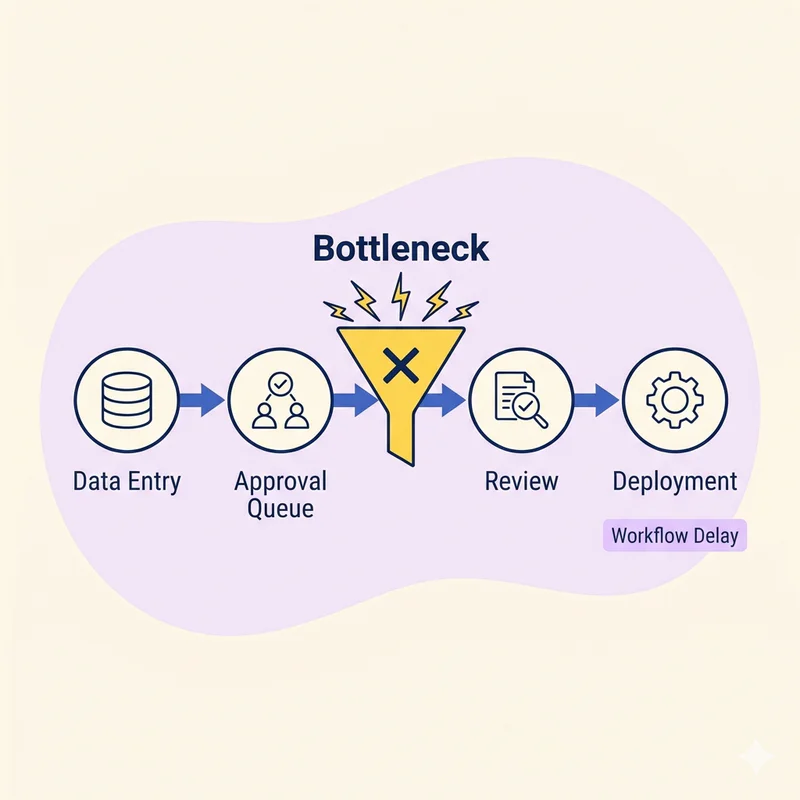
A business process bottleneck is any point in your workflow where tasks pile up, slow down, or require manual intervention to keep moving.
Think of it like a highway during rush hour. Traffic flows smoothly until everyone hits the same narrow bridge - that's your bottleneck.
Types of Operational Bottlenecks

System Bottlenecks: Manual data re-entry between platforms, integration failures requiring workarounds, slow processing speeds during peak volume.
Process Bottlenecks: Multi-level approval chains that delay decisions, handoffs between departments without clear ownership, exception handling requiring manual fixes.
People Bottlenecks: A single person who "knows how to fix that," team capacity maxed out during busy seasons, knowledge silos that block progress.
Data Bottlenecks: Multiple sources of truth causing confusion, real-time visibility gaps forcing constant status checks, reconciliation processes that happen manually.
Why Identifying Bottlenecks Matters
Research shows that organizations waste 20–30% of revenue on operational inefficiencies they haven't properly diagnosed.
When you don't identify business process bottlenecks before investing in ERP software or SaaS operations tools, you end up solving the wrong problem at significant cost.
The Financial Impact
Labor costs from overtime and firefighting
Lost revenue from delays in fulfillment or invoicing
Customer churn from poor service delivery
Technology spending that doesn't solve the real problem
Team burnout and high turnover
Opportunity cost from delayed growth initiatives
Competitive disadvantage while competitors move faster
Reputation damage from inconsistent delivery
Real-World Example
A ₹50 Cr manufacturing company couldn't figure out why orders were delayed despite having a "complete" ERP with 60+ features.
The bottleneck? Purchase approvals stuck for 2–3 days because nobody knew who to chase.
By identifying and fixing this ONE journey:
Approval time: 3 days → 4 hours
Team adoption: 40% → 90%
Cost savings: ₹8 lakhs saved monthly in carrying costs
Common Signs Your Business Has a Critical Bottleneck
Most bottlenecks hide in plain sight. Your team has normalized the chaos.
Red Flags to Watch For
System-Level: End-of-day "cleanup" rituals, batch processes failing frequently, teams asking "Did the file go through?" multiple times daily.
People-Level: Specific individuals becoming single points of failure, teams working overtime to catch up on routine work, chasing approvals via WhatsApp constantly.
Process-Level: Exceptions handled manually instead of systematically, multiple "special case" workflows, approval chains with more than 3 people, wait times exceeding 24 hours.
Data-Level: Different departments holding different versions of the truth, managers unable to answer basic questions without checking, spreadsheet-based reporting despite having business process software in place.
The Workaround Test
The most reliable bottleneck indicator: What workarounds has your team built?
If they're using WhatsApp for approvals or maintaining Excel trackers alongside your software, they've quietly replaced your system with one that actually works for them.
Manually re-entering data between systems or writing scripts to "fix" recurring issues isn't laziness. It's your team showing you exactly where your processes break.
The 5 Proven Frameworks to Identify Bottlenecks

Framework 1: Value Stream Mapping (VSM)
A visual tool that maps every step in a process from start to finish, showing where time and resources are spent.
Best for: Manufacturing and supply chain operations, repetitive processes with clear start/end points, identifying waste in established workflows.
Framework 2: Process Mining
Software that analyzes event logs from your ERP, CRM, or other systems to reconstruct how processes actually work - not how you think they work.
Best for: Companies with ERP/CRM systems generating event logs, complex processes with many variations, organizations needing objective data over subjective interviews.
Framework 3: The 5 Whys Technique
A root cause analysis method that asks "why" five times to drill down from symptom to underlying cause.
Best for: Recurring operational problems, issues with clear cause-effect relationships, quick diagnostics, human and process factors.
Framework 4: Workaround Analysis
Systematically mapping every workaround your team has built, then using those as diagnostic tools to find bottlenecks.
Best for: Organizations with low system adoption, identifying gaps between designed vs. actual processes, finding bottlenecks that don't show in system logs.
Framework 5: RICE Prioritization Method
A scoring framework to prioritize which bottleneck to fix first when you've identified multiple issues.
RICE = (Reach × Impact × Confidence) / Effort
Best for: Prioritizing when you've identified 5+ potential bottlenecks, getting stakeholder alignment on what to tackle, making data-driven decisions.
ERP Implementation Failure Causes
This is one of the most searched topics in operations management - and for good reason. Most ERP implementations don't fail because of the software. They fail because of what happened before the software was selected.
The Real Reasons ERP Projects Fail
No process diagnosis before purchase. Organizations select ERP software based on feature lists, not on a clear understanding of where their operations are breaking. The bottleneck gets digitized, not solved.
Fixing everything at once.ERP implementations that try to overhaul every department simultaneously create overwhelm, 18-month timelines, and delayed value realization. Teams disengage before go-live.
Designing for everyone means designing for no one. When every department gets a say in system design, the result is a bloated, over-complicated platform that no one fully adopts. Feature creep is an implementation killer.
Skipping change management. Technical success is not the same as implementation success. Without involving users from Day 1 and demonstrating clear before/after impact, even well-built systems get abandoned.
Trusting opinions over data. Teams often describe symptoms - "approvals are slow," "the system is confusing" - rather than root causes. Without data from system logs, timestamps, and workaround analysis, you end up solving the wrong problem.
No baseline metrics. If you don't measure cycle times, error rates, and process costs before implementation, you can't prove ROI after. This kills executive confidence and future investment.
The fix: Identify and resolve your ONE critical bottleneck first. Then implement operational workflow automation around a process that already works. This is what drives 80–90% adoption rates instead of the industry average of 40%.
How to Choose Which Bottleneck to Fix First
Not all bottlenecks are created equal. Here's how to identify the right one to tackle first.
The 6-Question Filter
Does it break daily or weekly? (Daily = higher priority)
How many people does it affect? (>50% of team = high priority)
What's the cost of delay? (Value per Week × Weeks If Not Fixed)
Can you fix it in 90 days? (Yes = good candidate)
Is it measurable? (Clear before/after metrics = yes)
Does anything else depend on fixing this first? (Standalone = good candidate)
You've Found the Right Bottleneck When:
Everyone agrees it's painful
It breaks daily, not occasionally
Multiple workarounds exist around it
It has quantifiable business impact
It's fixable in 90 days
Success is clearly measurable
It affects more than 50% of users
No dependencies are blocking the fix
Implementation: The 90-Day Fix Framework
Once you've identified your critical bottleneck, here's how to fix it fast.
The Minimum Viable Journey Approach
Don't build the complete solution. Build the smallest fix that unbreaks the journey. Many businesses make the mistake of purchasing full-suite SaaS operations tools when a targeted, scoped fix on a single workflow would deliver faster ROI.
The 90-Day Timeline
Weeks 1–2 : Discovery & Design: Confirm it's the right bottleneck, map current state, design minimum viable fix, get stakeholder buy-in.
Weeks 3–8 : Build: Iterative development, weekly demos to users, adjustments based on feedback, focus only on the core workflow.
Weeks 9–10 : Test & Train: Test with worst-case scenarios, peak volume validation, train super-users first, create quick-reference guides.
Weeks 11–12 : Go-Live & Stabilize: Pilot with one team first, intensive support during rollout, monitor metrics daily, fix issues immediately.
Week 13 : Measure & Learn: Compare before/after, gather feedback, calculate ROI, identify next bottleneck.
Common Mistakes to Avoid
Trying to fix everything at once. Team overwhelms, 18-month timelines, delayed value realization. Fix ONE journey, measure success, then move to the next.
Trusting opinions over data. Opinions reflect symptoms, not root causes. Use data -system logs, timestamps, workaround frequency, cost calculations.
Designing for everyone. Getting input from every department creates complexity. Design for the primary user journey and say no to feature creep.
Skipping change management. Technical success does not equal implementation success. Involve users from Day 1, show clear before/after benefit, and support intensively during transition.
Key Takeaways
70% of businesses have ONE critical bottleneck draining resources and limiting growth
Workarounds are diagnostic tools showing exactly where processes break
Use proven frameworks: Value Stream Mapping, Process Mining, and 5 Whys
Prioritize with data using RICE scoring or Impact vs. Effort matrix
Fix one journey at a time in 90-day windows for immediate impact
Peak volume reveals truth - test under worst-case scenarios
Measure before and after to prove ROI and identify the next bottleneck
ERP software and business process software only deliver ROI when the underlying process is sound first
Frequently Asked Questions
Q: How do I identify business process bottlenecks without expensive software?
Start with workaround analysis and the 5 Whys technique - both are free and highly effective. Map what your team does to bypass existing systems.
Q: What's the difference between a bottleneck and a pain point?
A pain point is any frustration in a process. A bottleneck is a specific constraint that limits overall throughput - when it's slow, everything downstream slows down.
Q: How many bottlenecks should I try to fix at once?
ONE. The Theory of Constraints states that every system has one primary constraint at any time. Fix the biggest bottleneck first, measure improvement, then identify the next.
Q: How long does it take to identify the main bottleneck?
Using the frameworks in this guide: 4–6 weeks for thorough discovery. Weeks 1–2: surface-level discovery. Weeks 3–4: deep analysis. Week 5: prioritization. Week 6: confirm and scope the fix.
Q: What's the ROI of fixing operational bottlenecks?
Organizations that fix their bottleneck first typically see 30–60% faster cycle times, 20–40% cost savings, and 80–90% adoption rates within 30–90 days.
That's the measurable difference between implementing operational workflow automation on a process that works versus one that was never diagnosed.
Conclusion
Your business doesn't have 47 equally important problems. It has ONE journey that's quietly breaking everything.
The companies that succeed don't try to boil the ocean. They identify the single critical bottleneck, fix it fast, measure the impact, and move to the next one.
Use the frameworks in this guide: Value Stream Mapping to visualize your processes, Process Mining to let data reveal hidden patterns, the 5 Whys to find root causes, Workaround Analysis to see reality, and RICE Scoring to prioritize with confidence.
Then implement the Minimum Viable Journey in 90 days.
Your next step: Spend this week conducting a workaround audit. Ask your team: "What processes do you bypass? What tools do you use that aren't official?"
Their answers will point you directly to your breaking point - and save you from investing in ERP software or SaaS operations tools that won't fix what's actually broken.
Because the journey that's quietly breaking your business isn't hiding. Your team has been showing you where it is all along.