You built a ₹15 crore business on hustle, speed, and a WhatsApp group that now has 2,800 unread messages in it.
That is not a failure. That is exactly how most Indian founders scale from zero to their first meaningful revenue milestone. WhatsApp is fast, familiar, and free. Your vendors are on it. Your field team is on it. Your biggest customers message you on it directly. For a ₹2 crore business, it works.
But somewhere between ₹5 crore and ₹25 crore, WhatsApp stops being an advantage and starts being a liability - and the bill it is running up is invisible until one bad month makes it impossible to ignore.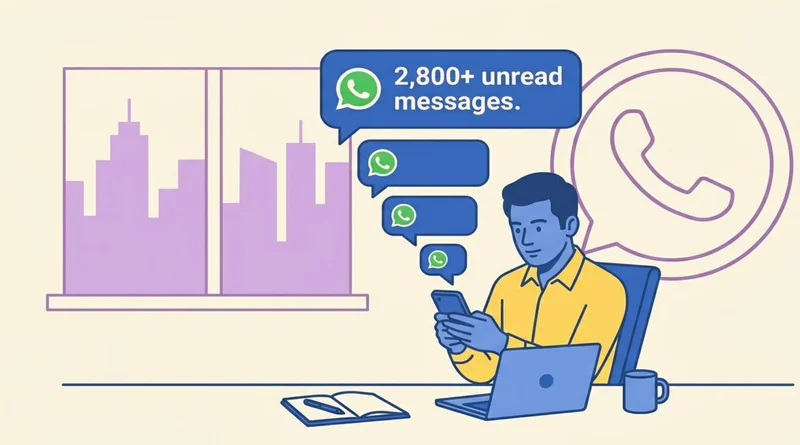
How Indian SMEs Ended Up Running on WhatsApp
It happened gradually, then completely.
In the early days, one WhatsApp group replaced a dozen phone calls. You could share a dispatch photo, confirm a vendor price, and approve a purchase order without leaving the app. It was faster than email and more reliable than calling.
Then the groups multiplied. Purchase team. Sales team. Warehouse. Vendor A. Vendor B. Channel partners. Marketplace escalations. Customer complaints. Franchise updates. By the time your business crossed ₹10 crore, you had 18 active WhatsApp groups and a team that spent 2–3 hours every day scrolling through them to find the message that mattered.
This is not a technology problem. It is a structural one. WhatsApp was built for conversation. You are using it as an operating system - for order management, approval workflows, vendor communication, quality control, and customer service simultaneously.
The system was never designed to carry that load. And the cracks show in your P&L every single month.
The Invisible Rupee Cost: What WhatsApp-Based Operations Actually Cost You
Most founders feel the friction of WhatsApp ops but cannot quantify it. Here is a breakdown by cost category, modelled for a ₹15 crore D2C or manufacturing business with a team of 15–30 people.
Lost and Delayed Orders
When orders come through WhatsApp from distributors, field agents, or marketplace partners - they live in individual chats. If the person who received that message is on a call, has a dead battery, or simply misses it in the scroll, the order does not move.
A conservative estimate: if your team misses or delays 15–20 orders per month due to chat burial, and your average order value is ₹4,000–₹8,000, you are looking at ₹60,000–₹1.6 lakh in lost or delayed revenue every month. That is before counting the customer who does not reorder because their first experience was slow.
Manual Double-Entry and Reconciliation Waste
Every WhatsApp confirmation that feeds into Tally, Excel, or a marketplace portal requires a human to re-type it. A field sales team of 5 people, each logging 10 orders a day via WhatsApp, generates 50 manual data entries that someone - usually a junior accounts or ops person - has to transfer into the actual system.
At 3 minutes per entry, that is 150 minutes of double-entry work every day. Across a 25-day month: 62 hours of productive capacity burned on data rekeying. At a fully loaded cost of ₹200/hour, that is ₹12,400/month in pure reconciliation waste - and that is one of the cheaper numbers in this list.
Quality Escapes and Returns
When a quality issue is communicated over WhatsApp - "that batch of 200 units has a label problem, don't dispatch" - it depends entirely on whether the right person in the warehouse saw the message, when they saw it, and whether they acted on it before the next dispatch run.
In a structured ERP with quality management, that batch would be automatically blocked from any pick list or sales order the moment the non-conformance is raised. In a WhatsApp-first operation, it gets dispatched 30% of the time because the message came at the wrong moment.
For a ₹15 crore D2C brand with a 3% defect escape rate on 500 monthly shipments: that is 15 defective dispatches per month. At an average reverse logistics + refund + replacement cost of ₹800–₹1,200 per unit: ₹12,000–₹18,000 in direct quality escape cost, monthly. Plus the marketplace seller rating damage, which is unquantifiable but real.
GST and Compliance Leakage
Vendor confirmations over WhatsApp mean your purchase team often processes invoices from memory or from a screenshot. Wrong GSTIN entered once, wrong HSN copied from a photo, GRN posted 3 days after goods arrived because the warehouse confirmation came via voice note to a personal phone.
Each of these creates an ITC mismatch in GSTR-2B. Each mismatch costs either your CA's time to reconcile or, if missed, a blocked ITC claim. For a business with ₹40–₹80 lakh in monthly purchases, a 1–2% ITC leakage from WhatsApp-driven reconciliation errors translates to ₹40,000–₹1.6 lakh in working capital either lost or locked every month.
The Hero Phone Problem
The most fragile part of any WhatsApp-operated business is not the app - it is the device. Your operations run on Rajan's personal phone because he is the one who manages the vendor group. When Rajan is on leave, in a meeting with bad signal, or simply unavailable, the entire vendor communication thread pauses.
There is no backup inbox. There is no SLA. There is no one else with context. The cost of this single-device dependency shows up as vendor payment delays, missed delivery confirmations, and expedited freight charges when things compound.
Conservative estimate for 2–3 such incidents per month: ₹25,000–₹60,000 in expedited costs and delayed payment discounts lost.
The Monthly Bill You Are Not Seeing
That is ₹18–₹50 lakh per year. Enough to fund a complete modular ERP implementation - two to four times over.
Why This Problem Gets Worse, Not Better, as You Grow

WhatsApp chaos scales with headcount and transaction volume. Every new team member adds another personal phone to the dependency chain. Every new vendor relationship adds another group. Every new channel - a new marketplace, a new distributor, a new city - adds another thread of unstructured communication.
The problems above do not stay flat as you grow from ₹15 crore to ₹40 crore. They compound. And after a certain point - typically when you have more than 20 people and more than 200 transactions per day - the chaos becomes structural enough that fixing it requires a deliberate systems intervention, not just better WhatsApp discipline.
The 8 Wastes of WhatsApp-First Operations
Lean manufacturing identified eight types of waste that reduce profitability without adding value. Every single one of them is amplified by WhatsApp-first operations.
The Framework for Getting Off WhatsApp Operations
Three proven quality and operations frameworks map directly to this transition.
PDCA: Plan–Do–Check–Act
WhatsApp-first operations skip two of the four PDCA steps almost entirely.
Plan gets skipped because SOPs live in someone's head, not in a system that enforces them.
Do happens at WhatsApp speed - fast and unstructured.
Check is nearly impossible because there are no dashboards, no timestamps, and no performance data.
Act depends entirely on whether the right person noticed the problem in the first place.
A modular ERP with built-in QMS restores all four steps. Plan: define workflows, approval rules, and quality gates inside the system. Do: execute orders, vendor interactions, and dispatches through structured flows. Check: real-time dashboards surface delays, misses, and defects automatically. Act: CAPAs (Corrective and Preventive Actions) are logged, assigned, and tracked to closure - not resolved over a voice note and forgotten.
DMAIC: Define – Measure – Analyze – Improve – Control
DMAIC, the Six Sigma improvement framework, gives you a language for the transition.
Define: Your business is running on WhatsApp. You are losing money but cannot see exactly where.
Measure: Count lost or late orders per month. Count escalations. Measure the time between a customer complaint and its resolution. Calculate your ITC mismatch value for the last quarter.
Analyze: The root cause in almost every case is the same: no ownership, no SLA, no searchability, no audit trail.
Improve: Shift the five highest-risk flows - orders, purchase approvals, quality non-conformances, vendor confirmations, customer complaints - into a modular ERP with defined owners and timestamps.
Control: Monitor response times, SLA adherence, and complaint closure rates via ERP dashboards monthly.
The 3-Layer Architecture: What Replaces WhatsApp
The goal is not to make your operations slower or more bureaucratic. It is to capture the same speed of chat but in a structured, measurable, audit-ready form.
Layer 1 - Data Capture: WhatsApp is fast because it is frictionless. The replacement must be equally frictionless. Journeyfy builds mobile-first forms, vendor portals, and lightweight apps that feel as immediate as sending a message but push data directly into the system - timestamped, attributed, and searchable.
Layer 2 - Process Engine: This is where workflows, approval rules, SLAs, and QMS gates live. Instead of "Please approve this PO - see screenshot," the system routes the approval request to the right person, tracks whether it was actioned within the defined timeframe, and escalates automatically if not.
Layer 3 - Intelligence: You cannot build a meaningful dashboard on top of WhatsApp logs. This layer is where Journeyfy's AI-powered product mapping and analytics sit - surfacing where you are losing time, money, and quality, and what to fix first.
FAQ
Q: Do I have to stop using WhatsApp completely?
No. WhatsApp remains useful for informal communication, relationship-building, and low-stakes updates. The goal is to remove high-risk, high-cost workflows - order approvals, purchase confirmations, quality alerts, vendor payments - from WhatsApp and into a system that owns the data, enforces the SLA, and keeps the audit trail. Your team will still use WhatsApp. They just will not run your operations on it.
Q: How do I calculate what WhatsApp chaos is costing me every month?
Start with five numbers: (1) orders lost or delayed per month × average order value; (2) hours per week spent in manual double-entry × team cost per hour; (3) quality escapes per month × average reverse logistics and refund cost; (4) ITC claimed vs. ITC available in your last GSTR-2B reconciliation; (5) expedited freight or vendor penalty costs from communication delays. Add them up. For most ₹10–25 crore Indian businesses, the total sits between ₹1.5 lakh and ₹4 lakh per month.
Q: How fast can I move core workflows into a modular ERP?
With Journeyfy's modular approach, the first workflow -typically inventory management or purchase order processing - goes live in 6–10 weeks. This is significantly faster than traditional ERP implementations because the scope is deliberately narrow: one journey, fixed first. You are not configuring an enterprise system. You are replacing one WhatsApp group with one structured workflow.
Q: Will my team actually adopt a new system?
Adoption fails when the new system is harder to use than the old one. Journeyfy builds mobile-first, chat-style interfaces that match the speed and familiarity of WhatsApp but push data into the system. In practice, teams adopt faster when the new system removes the friction they hate most - the scrolling, the double-entry, the "did you see my message?" rather than adding new complexity. Adoption is a design problem, not a training problem.
Q: We are at ₹8 crore. Is this too early to move off WhatsApp operations?
₹8–15 crore is actually the ideal window. Your processes are still small enough to document cleanly, your team is small enough to retrain quickly, and your transaction volume is large enough that the ROI is immediate and measurable. Waiting until ₹30 crore means fixing deeply embedded habits and cleaning 3 years of dirty master data. The cost of the intervention doubles. The disruption triples.
Talk to Journeyfy about replacing WhatsApp chaos with modular, audit-ready workflows. First module live in 6–10 weeks.ROI visible within 90 days. journeyfy.co | hello@journeyfy.co